ERC-1400: Security Token Standard for Regulated Assets
ERC-1400 is a modular security token standard with partitioned balances and compliance controls. How it works, when to use it, and how it compares to ERC-3643.

ERC-1400 is a modular Ethereum standard for security tokens that splits a single token contract into partitioned balances with independent compliance rules. Unlike a standard ERC-20 where every token is identical, ERC-1400 lets issuers create restricted and unrestricted tranches, enforce lockup periods, and manage multiple share classes — all within one contract.
#Why ERC-1400 Matters for Founders
If you're tokenizing a regulated asset with any structural complexity — different investor classes, vesting tranches, or restricted shares — ERC-20 won't cut it. You need a standard that treats your token as a financial instrument, not a fungible commodity.
ERC-1400 combines multiple sub-modules including ERC-1410 for partitioned balances, ERC-1594 for issuance and redemption, ERC-1643 for document references, and ERC-1644 for controller transfers (Source: QuillAudits). This modular design is what separates it from simpler token standards.
By 2026, ERC-1400 has become the leading standard for institutional tokenization projects due to its composable on-chain legal framework (Source: Blockchain App Factory). The standard's adoption tracks directly with the growth of RWA tokenomics across institutional markets.
"ERC-1400 strikes a balance between regulatory needs and blockchain innovation. It creates a framework where security tokens work within legal boundaries while staying transparent and efficient." — Primior, Security Token Standard Guide
We've helped dozens of projects through token standard selection as part of our advisory work. Here's how ERC-1400 actually works and when it's the right choice.
#The ERC-1400 Modular Architecture
The standard isn't a single interface. It's a framework we call the ERC-1400 Modular Architecture — four sub-standards that each handle a distinct stage of the security token lifecycle. You adopt the modules you need and leave the rest.
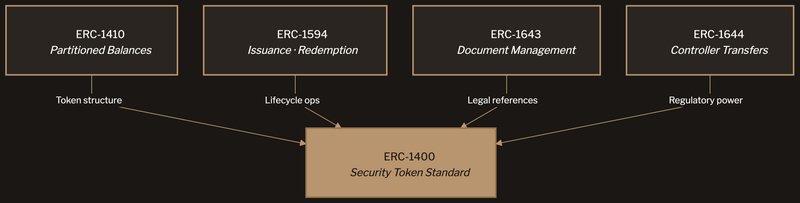
ERC-1410 — Partitioned Balances. The core innovation. ERC-1400 uses partitions via ERC-1410 for partial fungibility, enabling restricted and unrestricted token classes (Source: Zealynx). A single holder can own tokens across multiple partitions — say, a "vesting" partition and a "tradable" partition — each with independent transfer rules.
ERC-1594 — Core Securities Operations. Handles issuance and redemption with compliance checks. Before tokens are minted, the contract validates that the recipient meets all eligibility requirements. Redemption burns tokens and updates balances across relevant partitions.
ERC-1643 — Document Management. Links off-chain legal documents to the on-chain token. Offering memoranda, prospectuses, compliance certificates — all referenced from the contract with URI pointers and document hashes for integrity verification.
ERC-1644 — Controller Transfers. Enables authorized controllers to force transfers when legally required. Court orders, regulatory actions, lost key recovery — scenarios that securities law requires but standard ERC-20 can't handle.
#How Partitioned Transfers Work
The partition system is what makes ERC-1400 fundamentally different from ERC-3643 and other security token approaches. We call this the Partition Transfer Model.
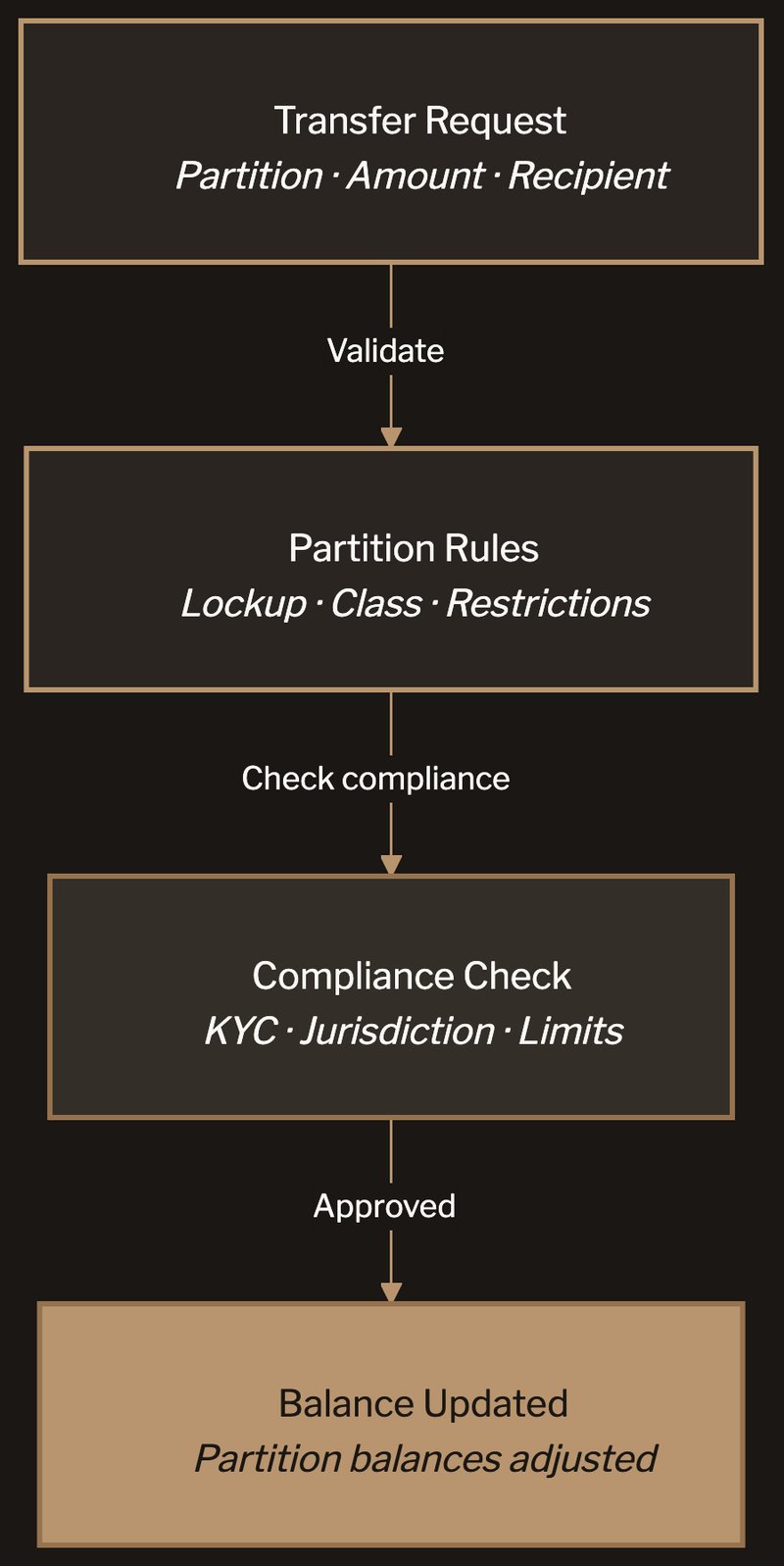
Step 1: Partition selection. When a transfer is initiated, the sender specifies which partition the tokens come from. A holder with 1,000 tokens in "restricted" and 500 in "unrestricted" can only transfer from the partition they designate.
Step 2: Partition-level rules. Each partition carries its own transfer restrictions. The "restricted" partition might enforce a 12-month lockup. The "unrestricted" partition might allow free transfer to verified holders. Rules are checked before any balance moves.
Step 3: Compliance validation. Beyond partition rules, global compliance checks apply. KYC/AML status, jurisdictional restrictions, and maximum holder limits are validated. The contract returns Ethereum Status Codes (EIP-1066) for any failure, giving the caller a specific reason rather than a generic revert (Source: Primior).
Step 4: Balance update. Only after all checks pass does the partition balance update. The sender's balance in the specified partition decreases, the receiver's balance in the corresponding partition increases.
This partition-aware transfer model means your tokenomics can have structurally different token classes without deploying separate contracts. Preferred shares, common shares, locked team allocations, and freely tradable tokens — all in one ERC-1400 contract.
#When to Use ERC-1400
Multi-class equity tokens. If your tokenized security has preferred and common shares, or Series A and Series B investors with different rights, ERC-1400's partition system handles this natively. One contract, multiple classes.
Tokens with vesting or lockup requirements. Partitions let you enforce lockup periods at the contract level. Team tokens sit in a "vesting" partition with time-based restrictions while investor tokens in a "tradable" partition move freely. No external vesting contracts needed.
Real-world asset tokens with complex structures. RWA tokenization frequently involves multiple tranches — senior debt, mezzanine, equity. ERC-1400 maps each tranche to a partition. Our EcoYield case study demonstrates how tranche management directly shapes tokenomics design.
Projects needing on-chain document references. If your legal team wants offering documents, compliance certificates, or audit reports referenced directly from the token contract, ERC-1643 provides that out of the box.
#ERC-1400 vs. ERC-3643: Choosing the Right Standard
We covered ERC-3643 in detail already. Here's the decision framework:
Choose ERC-1400 when your primary need is partition management. Multiple share classes, complex vesting structures, tranche-based assets. ERC-1400 gives you granular control over how different token classes behave within a single contract. You bring your own identity and compliance infrastructure.
Choose ERC-3643 when your primary need is automated compliance enforcement. ERC-3643 prescribes the identity system (ONCHAINID) and builds compliance checks directly into every transfer. Less flexibility on token structure, but more out-of-the-box compliance automation.
Use both when you need partition management AND automated identity-based compliance. The standards are complementary. ERC-1400 handles the structural complexity; ERC-3643's identity layer handles who can hold and transfer.
#Tokenomics Design Implications
Choosing ERC-1400 directly shapes your token model:
Partition design is allocation design. Your token allocation table maps to partitions. Team allocation, investor allocation, treasury, ecosystem fund — each can be a partition with its own rules. This means your tokenomics data room needs to document not just allocations but partition-level transfer restrictions.
Liquidity is partition-dependent. Not all tokens in your supply are equally liquid. Tokens in restricted partitions can't trade. Your liquidity model must account for which partitions contribute to circulating supply at any given time.
Controller powers need governance. ERC-1644's forced transfer capability is powerful and risky. Your tokenomics documentation must define exactly when controllers can act, who holds controller authority, and what governance process approves forced transfers. Investors will scrutinize this.
Gas costs scale with partition complexity. Each partition adds storage and computation overhead. A token with 2 partitions costs less per transfer than one with 8. Design the minimum number of partitions that meet your structural requirements.
ERC-1400 is infrastructure for security tokens that need structural complexity — multiple classes, tranches, or vesting partitions — managed within a single contract. The standard's modular architecture means you adopt only what you need. But modularity also means more design decisions upfront. Get the partition structure wrong and you're redeploying.
If you're building a security token and need your tokenomics to hold up under institutional scrutiny, book a discovery call. We'll assess whether ERC-1400, ERC-3643, or a combination fits your compliance and structural requirements. Sometimes neither is the right answer. We'll tell you that too.