Real Estate Tokenomics: Designing Property Tokens
Real estate tokenization demands different tokenomics than other RWAs. Here's how to design property tokens that satisfy institutional investors and regulators.


Real estate tokenomics is the discipline of designing token models for property-backed digital assets — defining how ownership is fractioned, how rental income flows to holders, how liquidity is provisioned, and how compliance is enforced onchain. It sits at the intersection of securities regulation, property economics, and mechanism design.
#Why Real Estate Tokenomics Is Different
Most tokenomics frameworks assume you're designing from scratch — creating new incentive structures for digital-native protocols. Real estate tokenization is the opposite. You're encoding existing economic relationships into smart contracts. The property already has tenants, cash flows, and legal obligations.
Deloitte projects tokenized real estate will reach $4 trillion by 2035, growing at a 27% compound annual rate from $0.3 trillion in 2024 (Source: Deloitte Center for Financial Services). The broader asset tokenization market is forecast to reach $16.1 trillion by 2030 — a 50x increase — according to ADDX and Boston Consulting Group (Source: Benzinga).
That growth is attracting institutional capital. But institutions don't buy hype — they buy structure. Your tokenomics needs to answer how revenue is distributed, how compliance is maintained, and what happens when things go wrong. We've advised 80+ projects through $100MM+ in combined raises and the pattern is consistent: property tokens fail when they ignore the economics of the underlying asset.
#The Revenue-First Property Token Framework
We use what we call the Revenue-First Property Token Framework for real estate tokenization engagements. It starts with the property's actual cash flows and works backward to token design — not the other way around.
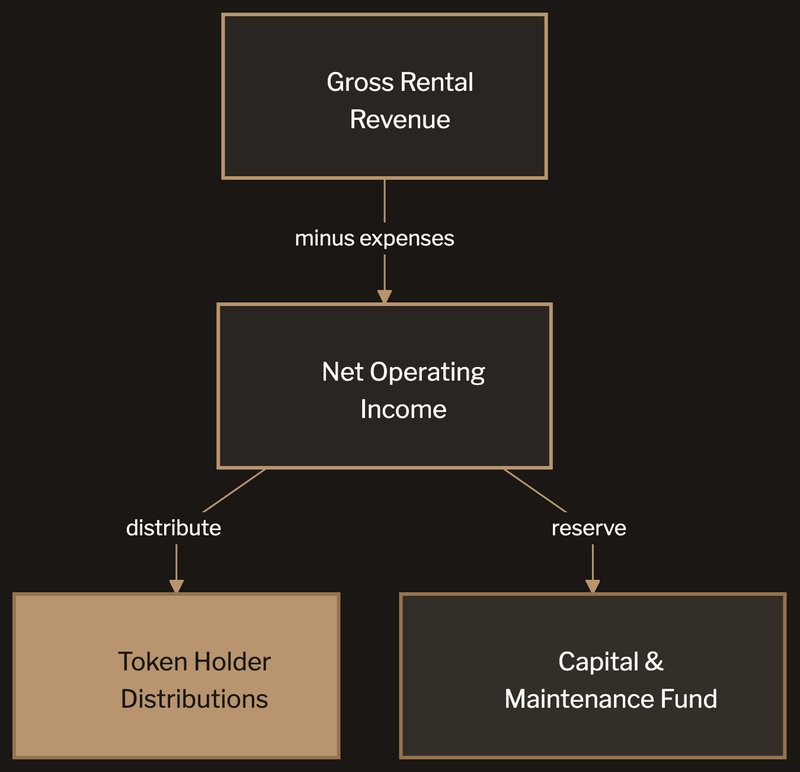
Start with net operating income. Gross rental revenue minus operating expenses, property management fees, maintenance reserves, and insurance. This is the distributable cash flow — the number that matters to investors.
Define the distribution mechanism. How does NOI reach token holders? Pro-rata distributions based on token holdings are the standard. Decide on frequency — monthly aligns with rental collection cycles. Build the distribution contract to be auditable and transparent.
Account for the illiquidity premium. Real estate is inherently less liquid than crypto-native assets. Your token model needs a liquidity reserve — typically 10-15% of supply — dedicated to market-making on secondary venues. Without it, investors are trapped.
Build in operating reserves. Property requires ongoing capital expenditure. Roofs need replacing. HVAC systems fail. A token model that distributes 100% of NOI is unsustainable. Reserve 5-10% for capital improvements and unexpected costs.
"Tokenized real estate disrupts this model by facilitating continuous trading that operates 24/7. Investors can respond to real-time market shifts — a critical advantage in today's always-on financial landscape." — Nathaniel Sokoll-Ward, CEO of Manifest (Wealth Management via Benzinga)
#Token Allocation for Property Assets
Real estate token allocations look fundamentally different from utility token allocations. There's no "community incentives" bucket or "ecosystem development" fund. Every allocation maps to a real-world stakeholder with legal rights.
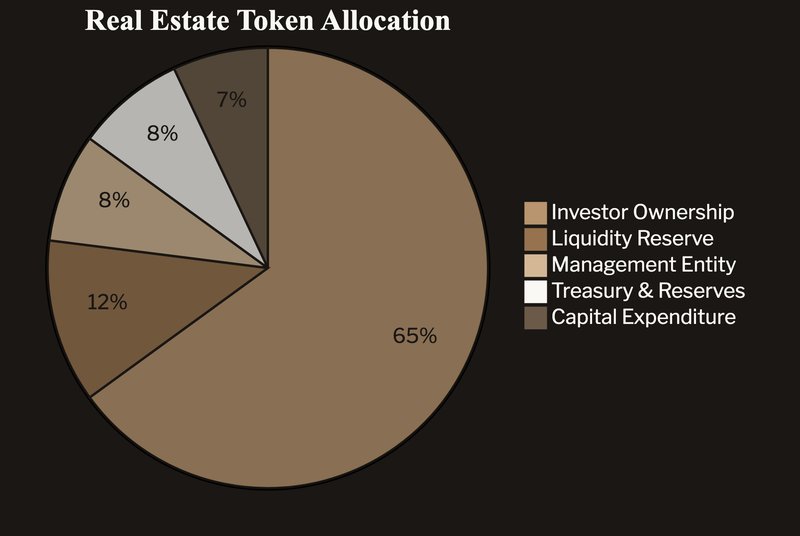
Investor allocation (60-70%). This is the fractional ownership component. Each token represents a proportional claim on the property's value and income. The exact percentage depends on how much equity the sponsor retains and whether debt financing is layered underneath.
Liquidity reserve (10-15%). Dedicated to market-making and secondary market support. Without adequate liquidity provisioning, your token will trade at a steep discount to NAV. Plan market-making partnerships before launch, not after.
Management entity (5-10%). The property manager or sponsor takes an allocation for ongoing operations — property management, tenant relations, maintenance coordination, and regulatory compliance. This aligns the operator's incentives with long-term property performance.
Treasury and reserves (5-10%). Capital expenditure reserves, insurance buffers, and emergency funds. These tokens are typically locked and governed by transparent rules for when and how they can be deployed.
#Compliance as Infrastructure
Real estate tokens are securities in virtually every jurisdiction. This isn't a gray area. If your token represents fractional ownership in a property that generates rental income, regulators will treat it as a security. Your tokenomics must be built on that assumption.
The U.S. GENIUS Act passed in 2025 and the anticipated Clarity Act in 2026 are providing clearer regulatory frameworks for tokenized assets (Source: BDO USA). But clearer doesn't mean lenient. It means more defined expectations for how compliant tokens must operate.
Token standard selection matters. ERC-3643 embeds identity verification and transfer restrictions directly into the smart contract. For real estate tokens targeting institutional investors, this is the baseline expectation. Your token standard choice determines what compliance is possible at the protocol level.
KYC/AML is non-negotiable. Every holder must be verified. Every transfer must check compliance rules. This adds friction and cost — factor it into your fee model and user acquisition estimates.
Jurisdictional restrictions are complex. A single property token may need different compliance rules for U.S. accredited investors, EU MiCA-compliant participants, and Asian markets with their own frameworks. Your compliance module needs to handle this composability.
Our EcoYield case study shows how we structured compliance for an RWA project — the approach applies directly to real estate tokenization. The full compliance documentation belongs in your tokenomics data room.
#Common Mistakes We See
After advising dozens of RWA projects, the failure patterns are predictable:
Ignoring property economics. Teams design tokenomics in isolation from the asset's actual financials. Your token model is only as good as the property's net operating income. If the property doesn't cash flow, no amount of token engineering will save it.
Underestimating compliance costs. KYC onboarding, legal opinions per jurisdiction, ongoing regulatory reporting, and compliance infrastructure aren't cheap. We've seen projects budget 2% for compliance when the real number is closer to 8-12% of operating costs.
Skipping liquidity planning. The global real estate tokenization market grew 308% over three years to reach $24 billion in 2025 (Source: Inmobiliario.do). But growth in total market value doesn't mean liquidity for your specific token. Plan your secondary market strategy before launch.
Over-distributing income. Distributing 100% of rental income as yield sounds attractive but leaves nothing for capital expenditures, vacancies, or market downturns. Sustainable beats aggressive.
#Getting Your House in Order
Real estate tokenomics isn't about clever mechanics. It's about encoding sound property economics into transparent, compliant, and investor-grade token structures. Revenue comes first. Compliance comes second. Everything else follows.
The market is growing fast — InsightAce Analytic values it at $3.73 billion in 2025 with projections to $23.99 billion by 2035 (Source: InsightAce Analytic). But growth doesn't forgive broken tokenomics. Get the fundamentals right, and institutional capital will follow.
If you're tokenizing real estate and need your tokenomics to hold up under institutional scrutiny, book a discovery call. We'll assess your project and tell you whether we're the right fit. Sometimes we're not. We'll tell you that too.